Friday, March 19, 2010

Revision Reschmision II

Revision Reschmision II

shooting-star-wallpapers_9475_1600x1200 As some of you know, I’ve been working through an online revision course for Steam Palace. The first half of the course was a detailed examination of my  draft, including analyzing scenes, plots, characters, settings, and consistency. It hasn’t really touched structure and style. But now I find myself at an impasse. I have a vision of what the book should be, and I want to start writing it. Over the last couple weeks, I’ve been rewriting certain scenes, trying to gain a feel for what the new version will be like.

The course is wanting me to build scene cards, mark keep/change areas, blah blah blah, but my plan is to completely rewrite everything., Every single line. The reason is simple. Although I had an outline for my first draft, when I sat down to write it, all I wanted to do is to get my idea for the book down on paper. I rushed through the draft, not worrying about anything. The result is a mix of good and bad (mostly bad), but rewriting is far more effective that revising.

Revision is different from drafting. In this revision, every line, every word counts. When I was drafting, I could crank out 5000 words a day. With revision it’s closer to 500, and I’m writing copious notes to make sure I don’t drop threads. But that’s not the main difference. I know where the story’s going. I know what the character relationships are. I’ve thrown out 3 characters and replaced them with far more interesting people. I’ve ripped out the middle and replaced it with something deeper. I’ve taken my setting and cranked it up a couple notches, raising the stakes up to where a true Sci-Fi story should be.

Here’s the thing. In my heart, I’m a pantser. I’m not a plotter or an outliner. I can’t sit around for the next 2 months plotting out cards for every possible scene. Yes, organization helps me. Having an outline made drafting immeasurably easier. But organization is not my strength. I’m a problem solver, and I’m creative thinker. I can’t plan everything out to the Nth detail.

At a critique meeting the other day, a newbie was incredulous that I could imagine a world with imaginary characters. I explained that it’s a simple process. What you’re looking at right now is a bunch of dots on a screen, but your brain sees it as something else. Imagination is the same. I see a setting, some characters, and some issues, then my brain interprets that as a story. You “imagine” stuff all the time, you just don’t know it.

This is why I’m kind of giving up on the course. I don’t want to draw dots. I know I haven’t figured out every problem that I have in the story, but my imagination is begging that I start crafting full scenes, not just one-line summaries which don’t really tell me what happens in a scene. My brain has connected all the notes I’ve made, and is ready to tell the story as it should be.

This week I created a new prologue for my story…just for fun (please no anti-prologue lectures). I may or may not include it in the final revision, but something I read in the coursework really made me think, and I’ll paraphrase here:

Do not write any scenes or include any characters that you are not dying to write.

That really struck a chord with me. I knew during drafting that there were a bunch of scenes that I “got through” because they “needed” to be in there. Then when it came time to print out a chapter for my critique group, I sometimes skipped the boring scenes. After learning this, I realized that

  1. If it’s not fun for me, it’s not fun for the reader.
  2. Some of my characters are just plain boring and don’t add to the story.
  3. I will only include stuff that I am determined to share with the world because it’s so awesome.

Note that this does not apply to first draft. You’ll drive yourself crazy trying to make every scene perfect and you’ll never finish. In your first draft, include every piece of crap that comes to mind. But during revision, everything counts.

And now, without further ado, here is a snippet of my new prologue, a highlighted bit that appears above the chapter header.

One sister will marry, one sister will die;
The day that Belonia drops from the sky.

“Belonia” is a strange star that’s been in the sky for 450 years. It travels across the sky backwards, counter to the Sun and Moon. There used to be four of them, but now there’s only the one. A crazy old witch lady issued this prophecy. I’m not sure it fits the story, and the name sounds a little like “Bologna” (I used an online name generator), but I had a lot of fun writing it. And maybe that’s the secret.

Do you make sure everything in your novel is included for a reason…and that the reason isn’t “it has to be in there”?

Friday, February 26, 2010

Revision Test Results!

Revision Test Results!

In my previous post, I ask you to consider which of two versions of the same scene was better. Here are the results:

  1. Which version did you read first?
    Everyone read #1.
  2. Which version interested you more in reading the whole story?
    #1-8
    #2-1
  3. Which version would you say is better? Why? (briefly)
  4. #1-8
    #2-1
  5. Which do you think is the revised version?
  6. #1-6
    #2-2

And now for the dramatic reveal:

You were (mostly) right! #1 is the revised version!

Here’s the story. I wrote this originally about 15 years ago for a creative writing class at the local university. So when I looked at it again, I had very fresh eyes. #2 is definitely not first-draft, but it reflects kind of “where I started.” I wrote the revision from scratch, creating a new outline and throwing out the old story. Here is a list of things I changed between the two versions you see:

  1. Deeper POV. Even in first person, you can still distance your readers from your characters. There’s a difference between a character explaining, “oh here’s something that happened to me that might be interesting” versus “you have to hear this. You won’t believe what I’ve been through. I want you to really understand what I’ve been through.” It really comes down to the old “showing vs telling” maxim. In version #2 he seems annoyed. In version #1 he’s enraged.
  2. Sparse description. In #1 I have maybe 4 adverbs, and looking at it now I can probably remove at least 2 more. I have 7 in #2. Adjective counts are similarly slanted. In fact, the one line of description, about the sky, needs to go as well. I’m thinking I want him to shade his eyes against the sun instead of just noting it. Then the harsh glare becomes more important, but I still get in the hint that we’re not on Earth.
  3. Almost no backstory. Instead of explaining why the narrator doesn’t like androids isn’t as effective as him railing against them. I have even less explanation of who Nancy is as well. It’s not that important.
  4. Inner dialog. It puts the reader into the narrator’s head, instead of hearing his impressions almost second hand. This makes everything more immediate.
  5. The character acts. In every paragraph, he does something. In #2 he’s just an passive observer.
  6. Other style changes. Variable sentence length, smaller focused paragraphs (that second paragraph in #2 actually goes on for  ~150 more words), voice, etc.

Here are some additional things I did to the story that aren’t evident from this small section:

  1. Reduced word count from 10K to 8K words. There was a lot of backstory in there, as well as either unimportant scenes and/or unnecessary exposition.
  2. Eliminated four characters, added one. He interacts with a lot of people, but I thought that was too much for this length of story, so I combined a few of them into one character.
  3. Reduced scene count from 19 to 13. Combined redundant scenes, eliminated some “traveling” scenes.
  4. Added new ending. The original story really had no Dénouement so I figured out how to tie everything together in a way that hopefully will elicit some OMG’s from my readers.
  5. Added conflict everywhere. Every page, every scene, every paragraph. This is a man who is struggling to avoid the Stockade himself, so there’s a high level of tension throughout.
  6. Story Structure. I’ve used Hero’s Journey and other structures to ensure that the story flows nicely.
  7. Better world building. I added a few twists in there to give the reader pause. But I dole out the world in dribs and drabs, and I try not to explain everything. I want people to want to re-read the piece to find all the clues/breadcrumbs I left for them.

One comment I have about the original version #2: a couple people noted that they like a couple things about #2, but those elements don’t really work in the revised version, so they’re left out on purpose. The lesson here is to not get too attached to any version or concept in your work, and feel free to kill your darlings, to eliminate things that don’t work anymore.

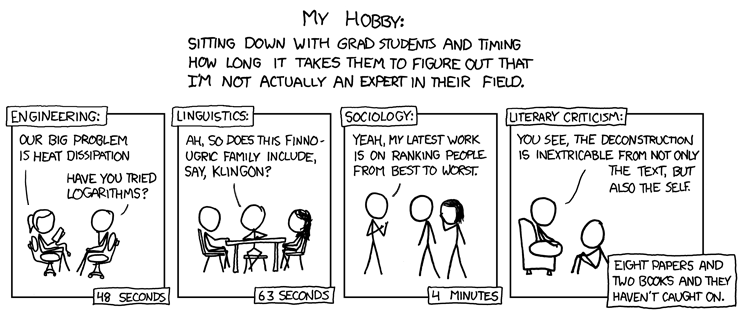
Thanks everyone for your input, you’ve given me hope that I really am improving my craft! And now for some XKCD love.

impostor[1]

Wednesday, February 24, 2010

Revision Test!

Revision Test!

21_SS-RevisionCD I’m conducting a test of my revision skills, and I need your help! I’ve re-written a short story called “Android” and I’d like your input to see if I’ve actually improved anything. Below I have two versions, #1 and #2, basically the first ~250 words of the original version, and the revised version.  I’m not telling you which is which. Read through both, and then answer the questions below. Feel free to email me your answers at iapetus999 at gmail dot com. By the way, feel free to read either version first, just note which one it was.

Version #1

The harsh tone tore through my head. I dropped my tools and turned towards the window of my store. There, over in the town square, the procession dragged the struggling figure through the streets. My hands shook as I hustled out my customers and locked up my store.

Not another one. Not so soon. Not another android.

The crowd assembled in minutes. Anyone within the range of that tone would come running. The figure screamed and struggled as they pulled it up onto the Stockade, clamping its arms and feet to the metal beams. The sun shone high in a deep green sky, casting few shadows and warming my neck. The crowd buzzed with anticipation and dismay. I stepped closer, wondering whom the androids had stolen this time. I stopped in my tracks. Nancy Perkins? She was one of my regular customers. A wife, a mother—I considered running away, unable to stomach the thought, but this monster up on the stockade, it had to pay. They had to be stopped, one way or another. We had to remain ever vigilant against the android invasion.

I pushed my way up to the front. I wanted to know: how did an android completely replace Nancy Perkins down to the last detail? This thing in front of us, this awful, soulless creature was created to deceive us. But I knew underlying that soft, human exterior lay the cold metal of an unfeeling robot, simply programmed to subvert our community and our way of life. What had become of Nancy? Was she killed? Tortured? I shuddered to think about it.

Version #2

The throbbing notes of the town bell pummeled my heart like a jackhammer. I snatched my jacket as I rushed out of my store to observe the horrible spectacle. The town square hummed with anticipation and dread. A quick question confirmed my worst fears: a horrible android had been caught, and would be dismantled. The faces around me echoed my fear and anger. This time the androids stole Nancy Perkins. I shook my head in dismay. The crowd erupted into rancorous shouts and curses as the android appeared. In the center of the town square the android clone of Nancy Perkins screamed and protested hysterically to the stern constables escorting it to the stockade. They handled it roughly, fearful of its android mechanical power. I had barely known Nancy. A mother of two, rarely frequented my store, but I had always thought of her as a kind, beautiful woman. The men cuffed its wrists to the arms of the machine, and firmly strapped its kicking legs to the base. They clamped its head to the back, until its only possible movement remained the rapid heaving of its chest and blinking of its eyes. The android’s protests and tears didn’t fool me. It was an android, how could it feel anything? It was just an act, an attempt to create pity so we might spare its life.

Ever since I could remember, I had hated androids. They were a blight on the world, an evil presence so profound I relished and celebrated their deaths.

Questions!

  1. Which version did you read first?
  2. Which version interested you more in reading the whole story?
  3. Which version would you say is better? Why? (briefly)
  4. Which do you think is the revised version?
  5. Any other thoughts? Ideas for improvement?
  6. Would you be willing to critique the whole piece (8000 words)? Send me an email offline.

Thanks for your time! I’ll tabulate the results and post them soon!

Monday, January 11, 2010

Story Structure Part XII: Return With The Elixir

Victory This is the twelfth in a series of posts talking about the story structure known as “The Hero’s Journey.” I’m borrowing heavily from“The Writer’s Journey: A Mythical Structure for Writers 3rd Edition” by Christopher Vogler. This is my interpretation of it, and I’ve tried to highlight some pitfalls I see writers falling into. Click here to review other installments of Story Structure.

Return With The Elixir

The End. The Dénouement. The Conclusion. The Epilogue. The Resolution. The Verdict. The Payoff. Whatever it’s called, we’ve come to the final chapter of our Hero’s Journey. We know what’s going to happen, and finally, our Hero is back home in the Ordinary World. But, it’s not the same world he started in. It’s changed. He’s changed. He’s undergone a traumatic transformation, and now returns home forever changed. “The Elixir” is the essence of this change, the lesson, the arrest, the anti-virus, the deciding vote, the surrender of the Enemy, the winning score, the hard-earned victory against incredible odds. Something he can carry with him for the rest of his life, and improve the lives of everyone he cares about.

It’s nice to show how your Hero has changed, to cement his transformation. In the initial Ordinary World, he was pushed around, taken advantage of, alone, in debt, or whatever problem he couldn’t overcome. Now he handles bullies with ease, is wise to the world, rife with friends, loaded with riches, and a master of his destiny. Of course, you don’t have to wrap up everything—don’t forget about that sequel—but make whatever final points you want to make.

I think this brings up the entire purpose of writing the book. The “Return” is where you draw your conclusion and illustrate your lesson. “Marriage is hard work”, “You must lead by example”,  “Grief is how we move on”, “Don’t ever cross a ghost”, etc. Did you make your point? Did your character experience enough consequences to warrant this ending? The ending justifies the meaning.

football win Now to conclude our Benchwarming Quarterback story. One final play, one last chance to prove himself, and he leaves the game. On the drive back to the hospital, he confesses his sins. He’s been a terrible son, a lousy quarterback, and a poor boyfriend. The cheerleader never meant to hurt him, but he seemed disinterested, so she strayed. He understands, and forgives her. Everything he’s done lately has been a failure, and even his attempt to redeem himself was false.

Now for the Lesson part. He must do the hard things. He can’t just waltz through life. When he arrives at the hospital, he has the Elixir. He’s back in his Ordinary World. Turns out—his father is fine, and in fact, is conscious. They found the game on the local cable channel. They beg him why he left the game and he tells them because his responsibility lay here…with the people he loves. Suddenly he has his father’s approval, and his girlfriend sees him in a new light. Turns out his Ally on the team caught the winning touchdown, so everything worked out in the end. It’s not a perfect ending, but we leave the story with the sense that things will work out.

Return With The Elixir Goals

  • Clearly demonstrate that the Lesson has been learned.
  • Tie up most loose ends, especially major subplots. If the airplane is going down, either crash it or save it.
  • It’s fine to leave a teaser for the sequel, but at least resolve something. I’ve read some books that just stop. Bad. How do I know there will be a payoff in the sequel, or will it just stop as well?
  • This is the part of the story where you show that you appreciate the time the reader spent reading your novel. Give them something to talk about. Make them wish the story never ended.

Non Goals

  • Don’t tie everything up. Note that in the QB story, we don’t know what’s going to happen with the girlfriend’s baby. We only know he’s be there to support her.
  • Don’t introduce more conflict here. This is the one point of your book where it’s fine if everyone agrees for once. There can be a implied conflict, such as “the whole city has burned and we need to rebuild, but at least we’ll do it together.”
  • Endings don’t have to be happy. They need to be conclusive. In “Paranormal Activity,” the ending is the credits (or lack thereof). But the Lesson is clear: Some people are just doomed. Get over it.

Next Installment: How to Apply the Hero’s Journey to your own writing, what it is and what it isn’t.

Friday, January 8, 2010

Revision Reschmision

Revision Reschmision

Revision_006-450w I decided to take an online (for a small fee) course on revision for my WIP Steam Palace. I’m not going to mention which one at this time because I want to run through the entire course first before promoting it, although if you’re dying to know, send me an email or follow me on Twitter. The concept of the course is “single-draft revision,” meaning that I take my rough draft directly to a final draft, using a bunch of worksheets and index cards as intermediary steps.

So far, it’s been a challenge. It’s been a lot of work, and I have dozens of pages of handwritten (which for me means nearly-indecipherable) notes. The idea is that I maintain a record of everything I write during this process in case I want to go back…but it seems to be turning into TMI. I’ve now spent 5 weeks doing nothing but reading my draft over and over from different angles and taking copious notes. This week, I’m trying to tease out all the conflict and figure out how to improve it.

Things I’ve learned so far:

  1. It’s more important to get the story right than the style. This was my mistake with my Dawn’s Rise revision attempt. I was so focused on my writing style that I completely ignored the content of the story, so my effort finally fell apart because I couldn’t get the story together. If this process works for Steam Palace, I might try to use it for Dawn’s Rise at some point.
  2. World-building is a double-edged sword. On one hand, it can kill your story by introducing tons of backstory and expository writing. On the other hand, it might be the only thing that sets your book apart from others. It’s what makes your novel unique.
  3. Conflict is King. Well, I didn’t really just learn this, but it’s something that’s becoming paramount in the revision process. It’s not just conflict overall in a grand sense, but conflict down to the scene/paragraph level.
  4. Analysis is hard work. And it’s wearing me down. I’m dying to write. I think best when I’m writing, not when I’m thinking about writing. So please, revision course, let me start writing!

I know I’m going to have to cut scenes, and perhaps rewrite large portions of the novel. The problem is, I don’t know what would be better than what I’ve written. I’m assuming the next few weeks of this course will reveal that, but right now, all I see are problems, and not solutions. I know the Climax is weak. I know the Ordeal is weak. I’m now getting worried about the beginning as well. The whole revision process is becoming overwhelming, mostly because I don’t have a clear picture of what the book should be. And without a concrete goal, it’s hard to know what direction to move in.

That’s probably what happens when you focus solely on problems for five weeks straight, you start seeing it as a unsalvageable piece of crap. What was I thinking? No one’s going to buy this. How am I going to turn a 240pg manuscript, 50 pages of notes and 104 index cards into a polished, marketable debut masterpiece? I guess that’s why I’m taking the course. Stay tuned.

(Thanks to InkyGirl for the comic)